Por las calles de la vida [Troilo-Fiorentino]

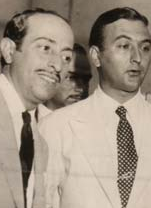
fiorentino

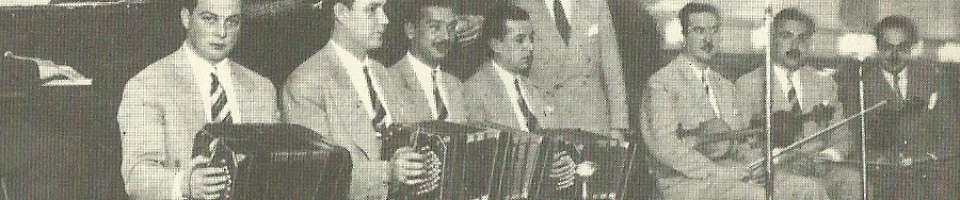
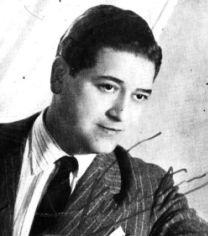
I have been working on quite a lot of Troilo translations during the last few months and I realize my selection has been a bit biased towards Alberto Marino. However, my interest in Francisco Fiorentino is in no way less serious. I generally prefer to dance to his early songs with Troilo but there is also a lot of great later material that are supposedly being overlooked dramatically. I have decided to translate one of the most curious titles in his repertoire and I hope you’ll enjoy some of the, in my opinion, very poetic elements in this lyric. I advise you to use my translation to take a look at the structure of the Spanish words in this tango, worth mentioning are excerpts like ”en mi vida oscura – como una pura – copa de alcohol” and ”mis sueños se derrumban – sobre la tumba – de esta pasión”.
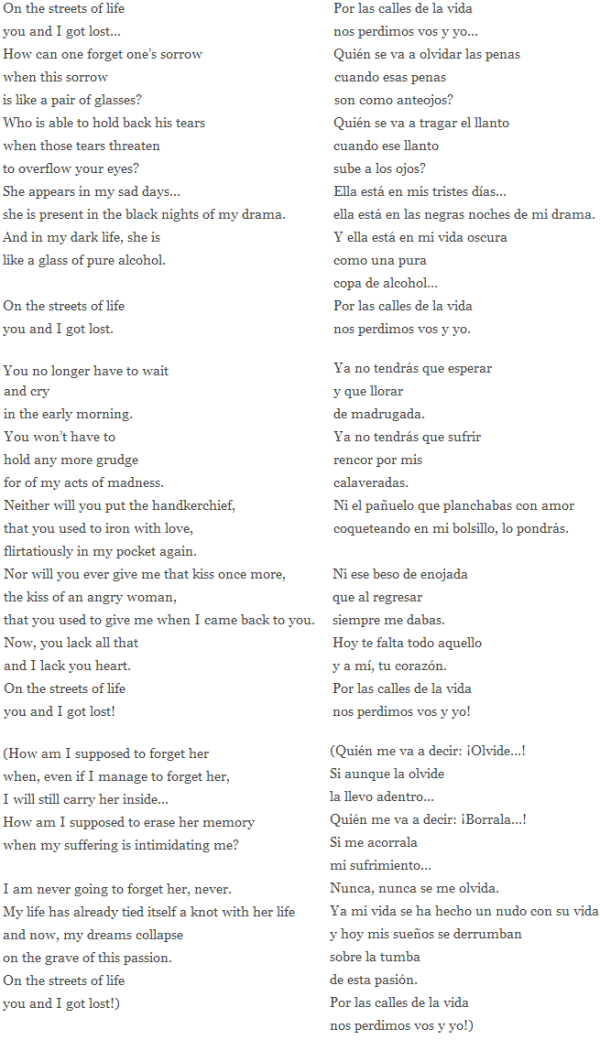
por las calles de la vida

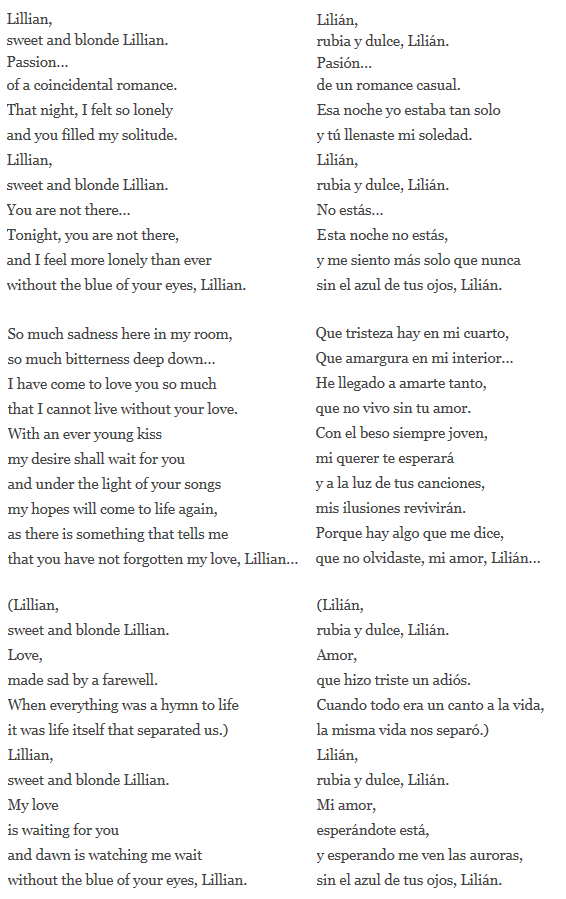
Lilián [D’Arienzo-Mauré]

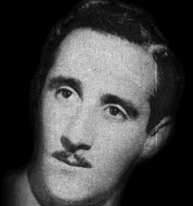
hector maure

Whenever someone asks me to mention one of the most accessible, universal themes in tango lyrics, the first thing that comes to mind is love. However, I also tend to add that the lyrics are much more focused on either the feelings that we associate with heartbreak or melancholic longing, than love itself.

These strong feelings can be expressed in grotesque, resentful ways, or, in contrast, the message may also be remorseful and full of nostalgia. But sometimes, those little anecdotes about love are ambiguous: the ”woman” might represent the country of origin of an immigrant, or whatever sentimental longing each of us will feel at a certain point in our lives.

Lilián is, in my opinion, mostly a metaphor and we will all interpret the poem differently. However, I’d say everyone will recognize the profound solitude that is being expressed in the song. In any case, this definitely one of my favourite tangos about loneliness and it would be hard not to feel sad after listening to it.

lilian tango

Sad comedy (Triste comedia) [Biagi]

hugo duvalOne of tango’s most widely shared (but also controversial) rules of thumb is…. after the Golden Age came to an end, the later the recording, the worse the quality. There is a lot of music from the late fifties onwards that is often referred to by many DJs as ‘tango-for-exporty’ (adjective). As far as my opinion is concerned, most of that material is indeed not so suitable for dancing and there is certainly a great deal of newer music that feels a bit corny, a bit trite. I do listen to a lot of post-Golden-Age music because I study the lyrics, and I love to find alternative versions by soloists. What’s more, there are also quite a few interesting songs that are not suitable for dancing but still very interesting from a cultural point of view.
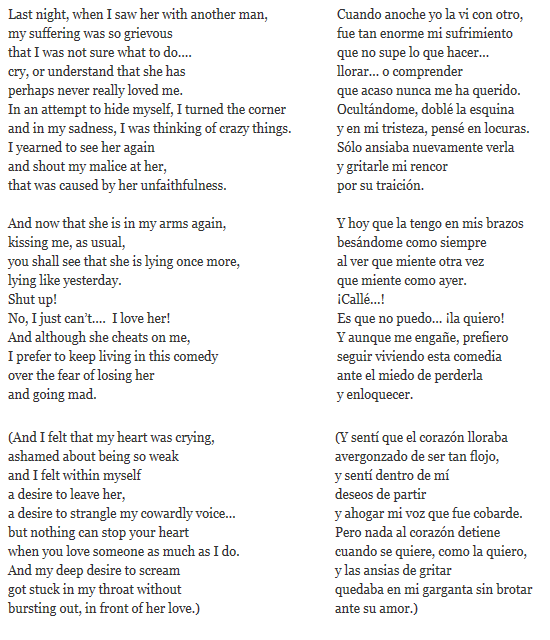
However, one of the exceptions that prove the rule is late Biagi with Duval. This combination seems to be popular with a lot of tango fans. I don’t think Biagi lost his touch, during a time when tango was starting to fade into obscurity. I like every single track that I have been able to find, especially Bailarina de tango, so it was just a matter of time until I would start translating one of them. This particular song boasts a nice variety of versions by excellent singers, feel free to stick with your own preference.

(6:00)

(5:35)

triste comedia

Disillusionment (Desencanto) [Orquesta Discépolo]

discepolo
Tango music is definitely not for the faint at heart, and this title is just another example of how dramatic many songs are. If you study the lyrics regularly and educate yourself about tango topics, you will inevitably start to make a lot of connections (for instance, in word choice), which make all the hard work quite a rewarding experience – your newly acquired knowledge will probably make your dancing, at least for yourself, much more intense and meaningful.

If I had to choose a single lyricist who can best summarize the darker side of tango poetry in a few lines, I would definitely say Discépolo. One of his favourite subjects was probably a combination of disillusion and betrayal. Songs like Soy un Arlequin, Infamia (both coming soon) and Confesión show a lot of particularly strong feelings, that at least in my case, have an uniquely devastating effect.

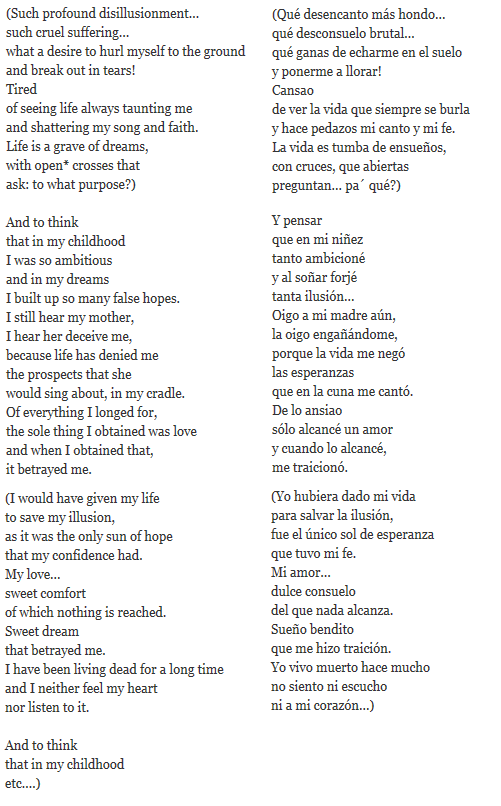
The strong content of the following song should, therefore, come as no surprise. Listen to Discépolo’s lover, the actress Tania, and to the orchestra that bore his name. The first version below (with limited lyrics) is also simply great in a musical sense.

desencanto

*I wonder how a cross could be open. In Marino’s version, the word is replaced by ‘a veces’, sometimes. The original words are, perhaps, a religious reference, which is quite common in Discépolo. I am not sure, though.

Futile (Inútil) [Maderna]

Osmar Maderna just might be the best musician you have never heard of. Well, I am actually sure you have heard his stunning piano playing a lot, because this man is one of the key reasons why the unforgettable recordings of Miguel Caló in the early fourties are really that unforgettable. Caló’s songs from that period always simply force me to dance, to move along the music, while I am constantly adoring omnipresent musical details.

However, nowadays, nobody seems to care about Maderna’s own orchestra… which is a shame, because his music is not only full of great ideas, but it is also true to the smooth, warm style of Miguel Caló’s best recordings. In fact, in my view, all the musicians who made the Orchestra of the Stars so good and then, quit, kept producing relatively good music. Yes, that means that Domingo Federico, Enrique Francini and Armando Pontier will also get some fully deserved attention soon.

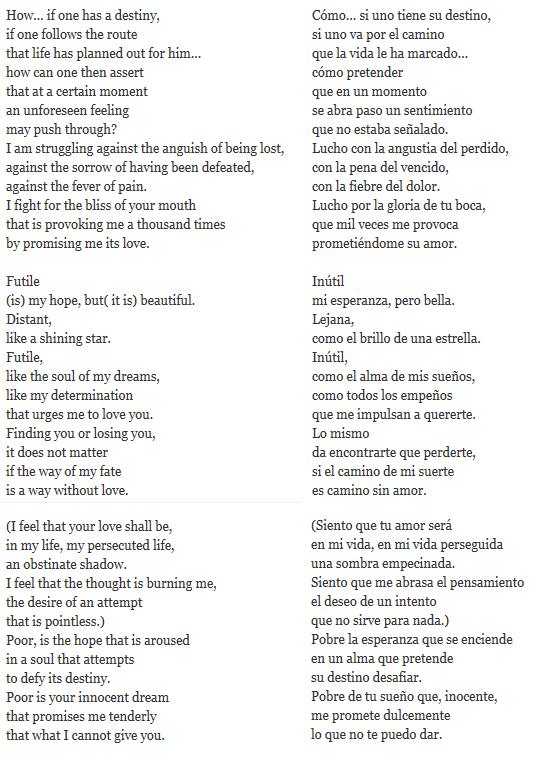
Immerse yourself in this rather complex poem about fate, tragic love, powerlessness and desperation.

inutil